
Love brought you together but as life’s pressures ensue, your relationship may suffer. Having children, losing a job, moving house, emptying the nest, extra family relationships, and health issues can be a catalyst for relationship breakdown. It’s rare that a partner is blind-sided completely by their partner (though this does happen to some) but rather a gradual drifting apart that is the greatest threat to relationship satisfaction.
- You remember and dwell on the negative aspects of the relationship more than the positive.
- Conflict rarely gets resolved.
- There is violence or abuse (physical, emotional, drug or alcohol).
- You rarely laugh together.
- You feel you or your partner are having or in danger of having an affair.
- You avoid sharing your true feelings with your partner to minimise conflict.
- Depression or other health problems are recurring.
- There seems to be secrets and trust is missing.
- Loss of desire for sexual intimacy.
In couples counselling, you and your partner meet together with the therapist where the relationship, rather than the two individuals, is the “client”. Sometimes couples counselling works best alongside individual counselling and your therapist can advise and arrange for this as well.
Expectations in Couples Counselling
One common goal of couples therapy is to enhance communication skills. This involves learning to express thoughts and feelings openly and honestly, while also actively listening to your partner without judgment. Through communication exercises and techniques taught by the therapist, couples can develop more effective ways of expressing themselves and understanding each other.
Another typical goal is to address underlying issues that may be contributing to relationship difficulties. This could involve exploring past traumas, childhood experiences, or patterns of behavior that are negatively impacting the relationship. By understanding these underlying factors, couples can work towards healing and creating a more fulfilling partnership.
Additionally, couples often seek therapy to rebuild trust and intimacy. This may involve addressing trust issues stemming from past betrayals or conflicts, and finding ways to reconnect emotionally and physically. Therapists may use techniques such as role-playing, trust-building exercises, and homework assignments to help couples rebuild trust and intimacy over time.
Overall, the goals of couples therapy are tailored to the specific needs and concerns of each couple. Whether it’s improving communication, resolving conflicts, rebuilding trust, or rediscovering intimacy, couples therapy provides a supportive environment for couples to work through their issues and strengthen their relationship.
Should We Start with Couples Counselling or Individual Counselling First?
One of the questions many couples ask when seeking help is whether they should begin with couples counselling together, or whether individual counselling for one or both partners might be the best first step.
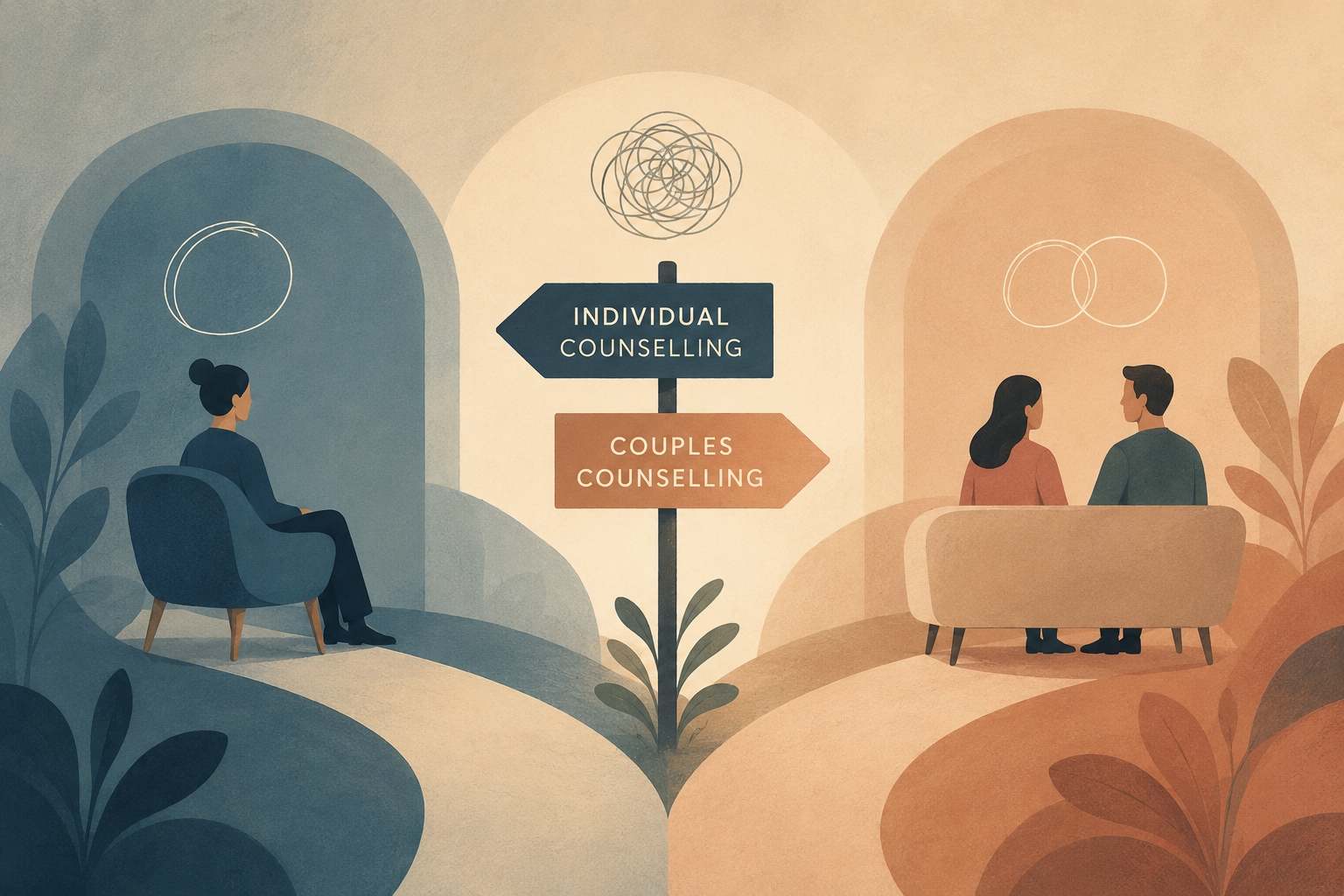
The answer is not always straightforward. Sometimes the main difficulty lies within the relationship itself—such as communication breakdown, recurring conflict, emotional disconnection, or trust issues. In other cases, one or both partners may be struggling with personal challenges such as trauma, anxiety, depression, emotional overwhelm, unresolved past experiences, or other difficulties that are significantly affecting the relationship.
Good couples counselling begins with careful assessment. The goal is not simply to ask “Can we work on this together?” but also “What kind of support will help us most right now?”
Below are some of the key areas therapists often explore when helping couples determine whether couples counselling, individual counselling, or a combination of both may be the most helpful starting point.
1. Is the Relationship the Main Problem, or Is an Individual Issue Driving the Conflict?
A helpful starting point is to explore whether the primary difficulty lies in the relationship itself or whether one or both partners are struggling with personal issues that are significantly affecting the relationship. Questions such as “When conflict happens, what do you think is at the heart of it?”, “If the relationship improved overnight, what personal struggles would still remain?”, and “Do either of you feel that your own anxiety, anger, trauma, depression, or stress affects how you show up in the relationship?” can help clarify whether the core work is relational, individual, or a combination of both.
2. Can They Regulate Enough to Do Couples Counselling?
Couples counselling requires both partners to tolerate discomfort, hear one another, and stay engaged without becoming overwhelmed. It can be helpful to ask “When conflict gets heated, can you each calm yourselves enough to keep talking?”, “Do arguments ever become so overwhelming that one or both of you shut down, explode, or leave?”, and “Can you hear difficult feedback from your partner without becoming immediately defensive?” Responses to these questions can help assess whether the couple has enough emotional regulation to engage safely and productively in joint work.
3. Is There Coercion, Fear, or a Power Imbalance?
Before beginning couples counselling, it is essential to assess whether both partners feel emotionally and physically safe enough to participate openly. Questions such as “Are there things you feel afraid to say in front of your partner?”, “Do you ever feel intimidated, controlled, or fearful in conflict?”, and “Do you feel free to disagree without consequences later?” can help identify whether coercion, fear, or significant power imbalance may be present, in which case individual or specialist support may need to come first.
4. Are They Motivated for Couples Work, or Hoping the Therapist Will Fix the Other?
Couples counselling tends to work best when both partners are willing to reflect on their own contribution to the relationship dynamic, rather than focusing solely on the other person. Questions such as “What are you hoping counselling will accomplish?”, “What do you think you might need to change—not just your partner?”, and “Are you both willing to look at your contribution to the pattern?” can help assess readiness for joint work and whether both partners are approaching therapy with openness and shared responsibility.
5. Is One Person in Acute Distress and Needing Stabilisation First?
Sometimes one partner may be struggling with mental health difficulties or acute personal distress that make couples work difficult to engage in safely or effectively. Questions such as “How is each of you functioning outside the relationship right now?”, “Is anyone feeling overwhelmed by depression, anxiety, trauma symptoms, substance use, or emotional instability?”, and “Has anyone recently experienced a crisis that needs immediate attention?” can help determine whether individual support may need to come first or alongside couples counselling.
6. Can the Couple Identify a Shared Pattern?
A useful indicator of readiness for couples work is whether both partners can move beyond blame and begin to recognise the cycle they get caught in together. Questions such as “What happens in a typical argument from beginning to end?”, “Can you see a repeating pattern you both get caught in?”, and “Do you experience yourselves as opponents, or as two people stuck in the same cycle?” can help reveal whether the focus can shift from “who is the problem” to understanding the relational dynamic itself.
7. Would Individual Therapy Help Someone Engage More Honestly in Couples Counselling?
At times, one or both partners may need space to understand their own emotions, experiences, or internal struggles before they can fully engage in joint work. Questions such as “Are there things you know you need to work on personally before you can really do this together?”, “Do you struggle to identify or express your emotions?”, and “Would it help to have your own space to process things before bringing them into couples work?” can help assess whether individual work may strengthen the couple’s future therapy.
8. What Are Their Goals and Level of Commitment to the Relationship?
It is also important to understand whether both partners are working toward the same goal and have enough commitment to engage in difficult relational work. Questions such as “Are you both wanting to strengthen this relationship?”, “Are you seeking repair, clarity, or support in deciding what happens next?”, and “Would either of you say you have emotionally checked out?” can help clarify whether the goal is repair, discernment, separation support, or something else.
There Is No One-Size-Fits-All Answer
For some couples, the relationship itself is the primary focus, and beginning couples counselling together makes sense. For others, individual work may need to come first—or happen alongside couples counselling—to help one or both partners build emotional stability, process personal difficulties, or gain clarity before working on the relationship together.
A thoughtful assessment can help determine the best path forward, so that therapy is not only well-timed, but also safe, effective, and genuinely helpful for both people involved.